
Robots that work where people work
Robin is a Physical AI robot built to share the floor with your team,
safely and on day one.
We build the soft actuation, the real-time force control, and the AI that runs on them. Robin is what happens when all three are designed together: a two-armed mobile robot that works safely beside people, without a cage.
Three layers, one company
Every layer of Robin is built in-house: the actuators, the real-time force control, and the physical AI. Because we own the whole stack, each layer is designed around the others. Customers get one integrated system, one team behind it, and one update path.
Soft actuation
Compliant force-controlled actuators of our own design, mechanically soft by construction rather than by software. Four US patents granted.
Real-time force control
Full-time closed-loop force control. Robin commands force directly rather than commanding a position and absorbing whatever force results. This is what the AI gets to build on.
Physical AI
A force-aware model trained in-house, plus the fleet software that maps, navigates, records demonstrations, trains policies and runs them. One system, one update path.
New skills and fixes reach the robot you already have as a software update. And because our actuators measure force at every joint, our model learns from touch as well as vision.
Roughly a tenth of the force
In our own comparative testing Robin generates roughly a tenth of the impact force of a conventional rigid arm under equivalent contact conditions. That comes from the actuator design itself, which is why Robin can work without fencing.
Illustrative diagram of the ratio, not test data. Both bars rise with contact speed; Robin’s stays roughly a tenth as high, and below the limit a person can safely absorb. Certified figures follow formal testing.
A specialist model, not a general-purpose one
General-purpose robot foundation models and our model solve different problems. Ours is built for one job: reliable, contact-rich industrial manipulation. That focus is how it reaches production-grade reliability with far less data and compute.
Force is a training modality, not a safety cutout
Force sensing at every joint feeds the model directly, alongside vision. Insertion, hand-offs and gentle placing work because Robin reacts to what it feels.
Around a hundred demonstrations, not internet-scale datasets
An operator teaches a new task in VR. Training and deployment run from one browser panel. New tasks go live in days.
Learned skills inside deterministic execution logic
The learned policy handles contact. Behavior trees handle sequencing, retries and recovery, so the robot stays predictable and recovers from faults on its own.
Real-time on the robot, with no cloud in the control loop
The full stack runs on the machine. Deploy cloud-connected, on-premise, or fully air-gapped.
| Generalist foundation models | Our model | |
|---|---|---|
| Purpose | One model for every robot and task | Purpose-built for industrial manipulation |
| Optimized for | Breadth of capability | Production-grade task reliability |
| Contact handling | Vision-first, position-centric | Force-native, feels and reacts to contact |
| Data required | Internet-scale datasets | Days of operator demonstrations |
| Compute | Data-center class | Real time, on the robot |
| IP position | Openly published | Proprietary, developed in-house |
The model, the training pipeline and the actuation it controls are developed under one roof. Capabilities reach customers as software updates on the robot they already have.
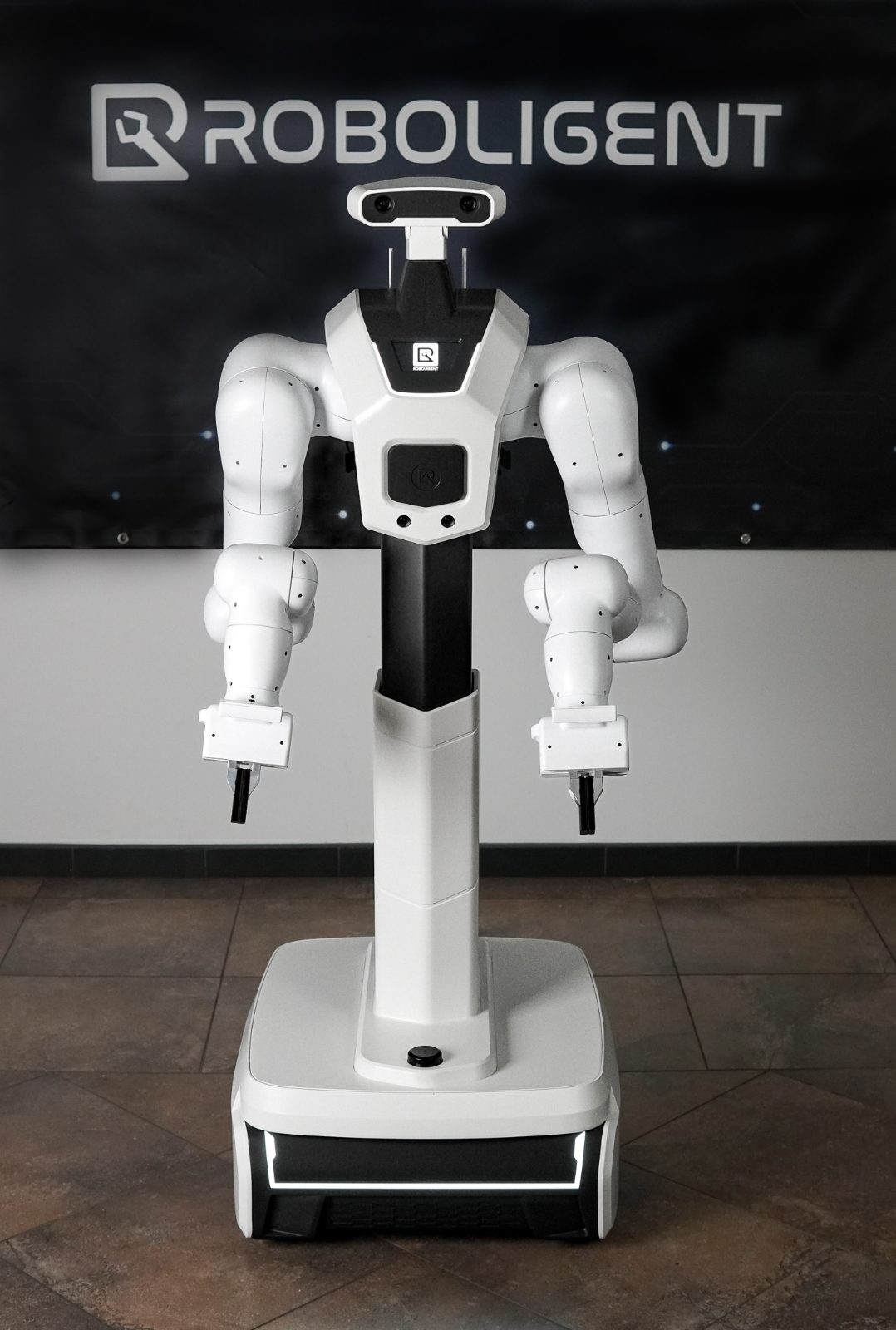
Meet Robin
Two 7-DOF arms on an omni-directional base, with a motorized lifting column that matches human workstation heights. Built to share the floor with your team.
Contact-rich handling work
The capabilities are primitive skills that compose into workflows, so one robot covers many processes on the same site.
Logistics and fulfillment
Our main application. Robin works at live pick stations alongside human workers.
- Tote and container handling between conveyors, racks and carts
- Item picking out of totes: mixed SKUs, varied geometry
- Heavy and irregular items, including non-rigid shapes
- Station-to-station transport with autonomous navigation
Automotive and manufacturing
Sequencing, kitting and line-side work where parts are heavy, varied, and sit in fixtures that demand contact awareness.
- Part sequencing from bin to rack, including pigeonhole insertion
- Mechanical assembly steps on engine-block-class components
- Line-side delivery and replenishment across shared floor space
- Fitting tasks where force feedback decides success, not vision
Electronics, display and semiconductor
Chemical handling: picking a bottle, opening a sealed cap, pouring powder to a target weight by the gram. Precision placement where excessive grip force damages the part.
Heavy and awkward payloads
Squeezing palms together to lift large boxes by friction, with no purpose-built gripper. Hugging items between both arms up to 20 kg. Pushing and pulling loads on and off an onboard lift cart.
You don’t buy a robot. You buy the work
Robin is provided under a subscription service agreement rather than a one-time sale. No capital purchase, no integration contract, no depreciating asset if the task changes.
Pilot
One robot, one station, your parts. Clear success criteria up front.
Deploy
We install and commission. Your operators are trained.
Expand
Add robots or move them to new tasks as your needs change.
What the subscription covers
- Robin hardware and accessories
- Maintenance, parts and labor
- Fleet software and security updates
- Firmware updates
- Remote and on-site support
- Installation and commissioning
Faults are reported to our service team automatically, so a support ticket opens without anyone filing it.
About Roboligent
Founded 2016 in Austin, Texas, out of research at UT Austin. We design and build the hardware, control software and AI ourselves.
Three on our compliant actuator and its internal assemblies, plus a granted design patent. Counterparts allowed in Europe, Japan, Korea and Canada; a gripper patent is allowed and awaiting issue.
Phase II contract from AFWERX, the U.S. Air Force innovation arm, with UT Austin as research partner, applying the same soft actuation and force control to physical rehabilitation.
An earlier National Science Foundation SBIR award backing the core actuation work.
Actuators, control software, the AI model and the fleet platform are all our own work, developed under one roof.
Designed, built and supported in Austin, Texas. Robin is assembled at our own facility in Round Rock, just outside Austin, by the same team that designs it. Service and engineering support come from the same building.
Open roles
Hardware, controls and AI sit in the same building in Round Rock. Everyone here touches something that ships to a customer.
Tell us what you want to automate
Pilots, spec sheets, partnerships or general questions. Send us a message and we’ll reply within two business days.